FREEHealthy 30-Minute Meals
(Instant Download)
Sign Up for instant access to your free cookbook plus our most popular quick and healthy recipes!
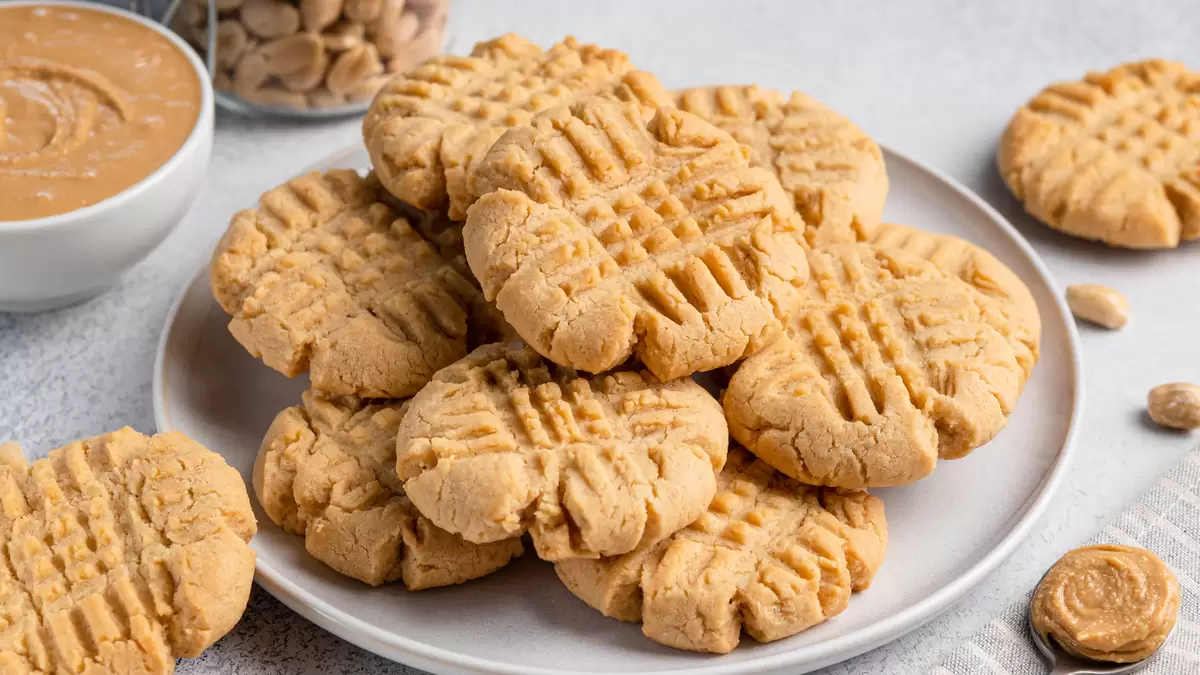
These healthy peanut butter cookies have everything you love about the classic, from the soft centers and lightly browned edges to the fork crisscross on top. Whole wheat flour and quick-cooking oats make up the dough, natural low-sodium peanut butter gives every bite its rich, nutty flavor, and just ⅓ cup of dark brown sugar sweetens all 30 cookies.
Plenty of healthy peanut butter cookie recipes skip the flour and butter entirely, and some people miss the classic texture when they do. This one keeps a little of both, so the cookies taste the way you remember. Each cookie has 107 calories, 3 grams of added sugar, and just 57 milligrams of sodium. The recipe was updated by our team, reviewed by Jane Schwartz, RDN, CLT, and approved for heart healthy, low sodium, diabetic, low cholesterol, and renal diets.
A few small changes to the classic recipe make a big difference in the nutrition:
They’re still a dessert, so one or two makes a good serving. But it’s a dessert that fits the way you’re trying to eat, and nobody at the table will guess it’s the healthy version.
(Instant Download)
Sign Up for instant access to your free cookbook plus our most popular quick and healthy recipes!
It depends on the recipe. Classic peanut butter cookies are usually made with refined white flour, a lot of sugar, regular salted peanut butter, and extra salt, so they can be high in added sugar and sodium. This version uses whole wheat flour, oats, low-sodium peanut butter, and less sugar, so each cookie has 3 grams of added sugar and 57 milligrams of sodium. They’re still a treat, but they fit into a heart-healthy diet when you enjoy one or two at a time. If you’re also watching calories, our low calorie peanut butter cookies collection has even more options.
Oats add whole grains and a little fiber, so healthy peanut butter oatmeal cookies can be a smart swap for cookies made with white flour alone. Many oatmeal versions leave out the flour completely. This recipe uses ½ cup of quick-cooking oats alongside whole wheat flour, which keeps the texture of a classic peanut butter cookie while adding whole grains to the dough.
Peanut butter can be part of a heart-healthy diet. Most of its fat is unsaturated, and like all plant foods, it has no cholesterol. The key is choosing the right jar. Look for natural peanut butter made with just peanuts, and pick a low-sodium or no-salt-added version when you can. It’s best to skip brands with added sugar or hydrogenated oils, and to keep portions in mind, since 2 tablespoons of peanut butter has about 190 calories.
At 375°F, cookies made from rounded tablespoons of dough take 9 to 11 minutes. Look for lightly browned edges and centers that still look a little soft. If you make smaller cookies, start checking them at 7 minutes, and keep in mind that changing the size also changes the yield and the nutrition per cookie.
Peanut butter cookie dough freezes well. Scoop the chilled dough onto a parchment-lined baking sheet, press the crisscross pattern with a fork, and freeze until firm. Then transfer the dough to a freezer bag and store it for up to 3 months. You can bake the cookies straight from the freezer, adding 1 to 2 minutes to the baking time.
Our dietitians approved these cookies for a renal diet. Each one has 57 milligrams of sodium, 76 milligrams of potassium, and 49 milligrams of phosphorus. Kidney diets vary from person to person, so check with your doctor or dietitian about how these cookies fit into your own eating plan.
The healthiest cookies are made with whole grains, keep added sugar and sodium low, and get most of their fat from foods like nuts and nut butters. Portion size matters too, since even a healthy cookie is still a treat. For more ideas, browse our 18 heart-healthy cookie recipes, each one reviewed by our dietitians.
If these become a favorite, our dietitians have reviewed plenty of other cookies that fit a heart-healthy diet:
Peanut butter shows up in a lot more than cookies on Health eCooks. Try one of these the next time you’re craving that nutty flavor:
This is an easy peanut butter cookie recipe, and a few small steps help it turn out right every time:
Every oven runs a little differently, so if yours tends to run hot, start checking the first batch at 8 minutes. That extra minute or two is often the difference between a soft, chewy center and a crisp one, and both are delicious.

Recipe yields 30 servings
In a large bowl, combine flour, oats, Kosher salt, and baking soda.
In another bowl, use an electric mixer to beat the brown sugar, peanut butter, and butter until smooth. Beat in the egg, egg white, and vanilla.
Add the peanut butter mixture to the flour mixture and stir to combine well. Cover with plastic wrap and refrigerate the dough for 30 minutes.
Place oven racks in the upper and lower thirds of the oven and preheat to 375°F. Line two baking sheets with parchment paper.
Drop rounded tablespoonfuls of dough onto the baking sheets, 2 inches apart. Flatten with a fork to make a crisscross pattern. Bake both sheets at the same time for 9 to 11 minutes, rotating the sheets top to bottom and front to back halfway through, until the edges are slightly browned.
Remove from oven and let cool on baking sheets for 2 minutes. Transfer to wire racks to cool completely.
Store cooled cookies in an airtight container at room temperature for up to 5 days, or freeze for up to 3 months.
Our nutrition information is calculated with Diamond Crystal kosher salt. If you use Morton kosher salt or table salt, use ¼ teaspoon instead of ½ teaspoon, since both are saltier by volume. That keeps the sodium close to 57 milligrams per cookie.
Any natural creamy peanut butter labeled low sodium, unsalted, or no salt added works well. Regular salted peanut butter will raise the sodium. You can also use almond butter for a milder flavor.
If you only have old-fashioned rolled oats, pulse them a few times in a food processor so they blend smoothly into the dough.
Light brown sugar works in place of dark brown sugar, though the cookies will have a little less caramel flavor.
For egg-free cookies, replace the egg and egg white with 2 flax eggs (2 tablespoons of milled flaxseed mixed with 5 tablespoons of water and left to sit for 5 minutes). The cookies will be slightly more tender.
Use a 1-to-1 gluten-free flour blend and certified gluten-free oats, or bake our Gluten Free Peanut Butter Cookies instead.
To make healthy peanut butter chocolate chip cookies, stir ⅓ cup of mini dark chocolate chips into the dough before you chill it.
Looking for your next bake? Browse our full collection of healthy cookie recipes, or explore more heart healthy recipes, low sodium recipes, and diabetic recipes for every meal of the day.