FREEHealthy 30-Minute Meals
(Instant Download)
Sign Up for instant access to your free cookbook plus our most popular quick and healthy recipes!
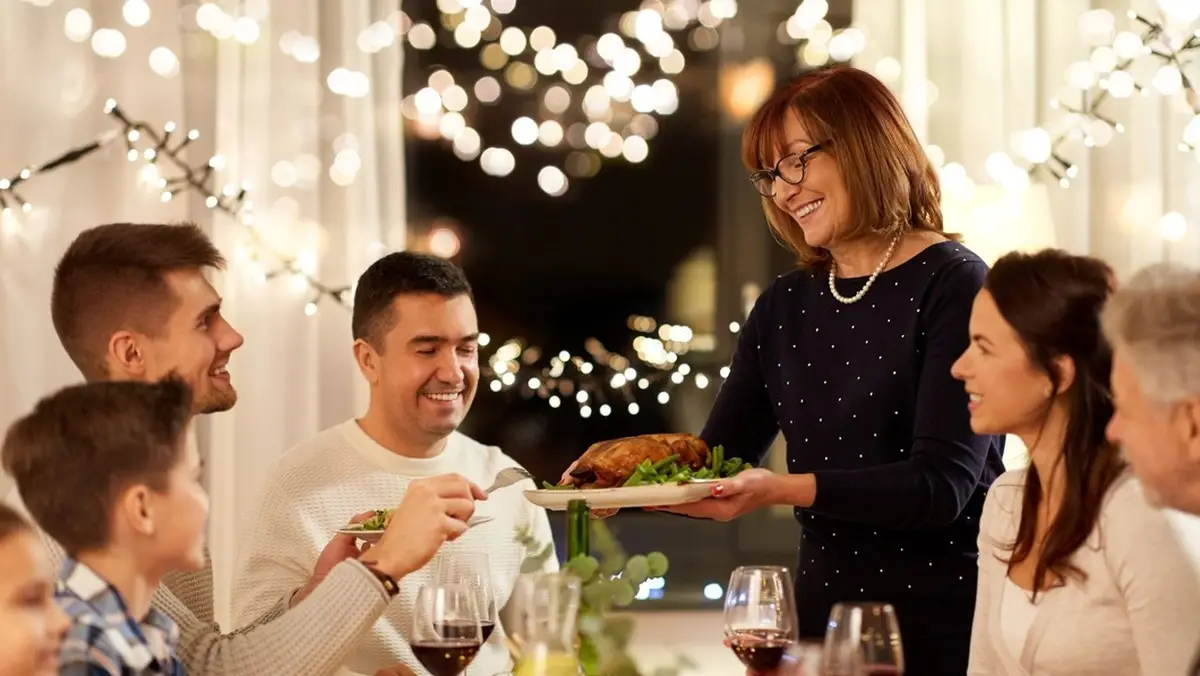
Hosting a big holiday meal should feel joyful, not stressful. But between choosing a menu, figuring out how much food to buy, and getting everything hot and on the table at the same time, it's easy to feel overwhelmed. Whether you're cooking Christmas dinner, a Hanukkah feast, Easter brunch, a New Year's Day spread, or a Sunday supper for the whole extended family, a holiday meal planner makes things simpler. With a smart plan in place, you can serve a delicious meal your guests will love while still enjoying the day just as much as they do.
This planner works for any holiday and any crowd, so you may want to bookmark it and come back to it year after year. It shows you how much food to make per person, offers lighter takes on classic holiday dishes, and gives you a step-by-step checklist that keeps everything on track. Every recipe we suggest was developed in the Health eCooks Test Kitchen and approved by our team of registered dietitians to balance taste and nutrition.
Planning a big meal comes down to 3 simple steps, and this guide walks you through each one:
Planning Thanksgiving dinner specifically? Our healthy Thanksgiving meal plan builds a full menu around the turkey, and this planner's portion guide and checklist work right alongside it.
The main dish sets the tone for the whole meal, and it's usually the most expensive thing on your shopping list, so it pays to get the amount right. As a general rule, plan on about ½ pound of boneless meat or about ¾ to 1 pound of bone-in meat per person. Here's how that breaks down for the most popular holiday mains, along with a few of our favorite lighter recipes.
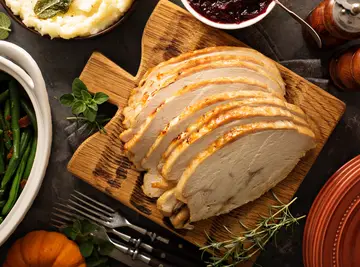
For a whole turkey, plan on 1 to 1½ pounds per person. The bones and carcass account for a lot of that weight, so go with the higher number if you want leftovers. A boneless turkey breast needs only about ½ pound per person. Our low carb Oven Roasted Turkey uses herbs and olive oil in place of butter and has 30 grams of protein in a 169-calorie serving. For a smaller crowd, the Roasted Turkey Breast with Root Vegetables cooks the main dish and a side on one pan.
A bone-in ham, including spiral-cut, needs about ¾ pound per person, while a boneless ham needs only ⅓ to ½ pound. Most store-bought hams are already fully cooked, so you're really just reheating them to 140°F. Because ham is naturally high in sodium, the side dishes are a great place to balance things out, and our ham sides collection has 15 light, easy options to choose from.
For a bone-in prime rib, plan on about 1 pound per person, which works out to roughly 1 rib for every 2 guests. A boneless rib roast or other boneless beef roast needs about ½ pound of uncooked meat per person, since it shrinks as it cooks. If prime rib is out of your budget (or you're looking for something leaner), our Top Round Roast Beef with Gravy is an elegant centerpiece with 35 grams of protein and 223 calories per serving. And it comes with its own gravy, so that's one less thing to make.
Brisket shrinks a lot during its long, slow cook, so buy about ½ pound of raw brisket per person. It's a classic for Hanukkah and a wonderful make-ahead main for any holiday, since it slices more neatly (and tastes even better) the next day. Our Beef Brisket and Vegetables has 186 calories and 20 grams of protein per serving, and you'll find more ideas in our Hanukkah recipes.
A boneless pork loin or tenderloin needs about ⅓ to ½ pound per person. Pork is one of the leanest holiday mains, and it cooks much faster than a turkey or beef roast. Our Maple Glazed Pork Loin Roast is sweet, festive, and just 145 calories per serving with 25 grams of protein. For something a little different, the Cocoa Rubbed Pork Tenderloin has 33 grams of protein and a rich, savory crust.
A whole roast chicken works out to about 1 pound per person, so a 4-pound bird feeds about 4 people. It's a great choice for smaller gatherings or as a second main. Our Low Sodium Roasted Chicken with Oranges and Herbs has 38 grams of protein per serving and fills the whole house with a citrusy, herby aroma.
Plan on a 5- to 6-ounce fillet per person. Fish is a lovely option for Christmas Eve or any holiday when you'd like something lighter, and it cooks in a fraction of the time a roast does. Our Brown Sugar Glazed Salmon has 26 grams of protein, while the Roasted Halibut with Mediterranean Tomato Sauce adds 6 grams of fiber thanks to its chunky tomato sauce.
If you have vegetarian guests, plan on 1 full main-size portion per person (such as half a stuffed squash) so they aren't left filling up on sides. Our Quinoa Stuffed Acorn Squash with Apples is pretty enough to sit at the center of the table and has 7 grams of fiber per serving.
Serving 2 mains, like ham and turkey? Cut the amount of each one roughly in half, then add a little extra, because most guests will want to try both.
Once the main dish is settled, the rest of the menu falls into place. Use these per-person amounts as your guide, and swap in the lighter recipes wherever they fit:
Keep in mind that the more dishes you serve, the less of each one guests will eat, since most people like to take a little of everything. If you're putting out 4 or 5 sides, you can scale each one back a bit. And if your family loves leftovers, it never hurts to make a little extra of the favorites.
Not sure what to do when? This timeline spreads the work out so the big day feels manageable. It works for Christmas, Hanukkah, Easter, or any holiday dinner, and it doubles as a Thanksgiving meal checklist too.
One Month Before
✔ Finalize your guest list and menu, including a mix of traditional and lighter dishes.
✔ Ask guests about allergies or dietary restrictions.
✔ Take stock of your serving dishes, platters, and utensils, and borrow anything you're missing.
Two Weeks Before
✔ Make a shopping list organized by store section so you don't forget anything.
✔ Shop for pantry staples, beverages, and other non-perishables.
✔ Order your main dish if you're buying a fresh turkey, ham, or rib roast from a butcher, or buy a frozen one.
One Week Before
✔ Make and freeze anything that freezes well, such as soups, casseroles, pie dough, or cookie dough.
✔ Plan your oven schedule. Write down what needs the oven, at what temperature, and for how long, so nothing ends up competing for space on the day.
4 to 5 Days Before
✔ If you're serving a frozen turkey, start thawing it in the fridge now. Allow 24 hours for every 4 to 5 pounds, so a 20-pound bird needs 4 to 5 full days.
2 to 3 Days Before
✔ Buy fresh produce, dairy, and seafood.
✔ Chop vegetables and store them in airtight containers.
✔ Make sauces, dressings, dips, and cranberry sauce, and refrigerate them.
Day Before
✔ Bake pies, crisps, and cheesecake so your oven is free for the main event.
✔ Assemble make-ahead casseroles and refrigerate them, unbaked.
✔ Move any frozen dishes to the fridge to thaw.
✔ Set the table, set out serving dishes, and label each one with a sticky note so you know where everything goes.
✔ Chill beverages.
Holiday Morning
✔ Get the main dish in the oven, leaving extra time so it can rest before carving. Use a meat thermometer: turkey and chicken should reach 165°F; beef roasts, pork, and fresh (uncooked) ham need at least 145°F followed by a 3-minute rest; a fully cooked ham should be reheated to 140°F; and fish is done at 145°F.
✔ Bake casseroles and roast vegetables while the main dish rests.
✔ Make anything that's best fresh, such as mashed potatoes or gravy.
Before Guests Arrive
✔ Set out appetizers and drinks.
✔ Double-check your list to make sure every dish is ready to go.
Just Before Dinner
✔ Carve the main dish, unless you're doing it at the table.
✔ Warm sides, toss salads, and set out bread or rolls.
✔ Bring everything to the table (and ask for help, because you don't need to do it all!).
✔ Light the candles, turn on some music, and gather everyone around the table.
After Dinner
✔ Get leftovers into the fridge within 2 hours. Our guide to storing leftovers safely explains how long each kind of food will keep.
✔ Pack up a plate or 2 for guests to take home.
Not sure how to feed a guest who's watching their salt, managing diabetes, or avoiding gluten? A little planning goes a long way, and it can make everyone at the table feel welcome:
You don't need to make a separate menu for every guest. A few thoughtful choices, like a lighter side or 2 and a vegetable-forward main, usually cover everyone. And if you're cooking for a smaller group this year, our holiday dinner for two menu scales everything down using turkey cutlets.
A good rule of thumb is about ½ pound of boneless meat per person, or ¾ to 1 pound of bone-in meat, since the bones account for some of the weight. For a whole turkey, plan on 1 to 1½ pounds per person, and go with the higher number if you'd like leftovers. If you're serving 2 mains, you can cut each amount roughly in half.
Plan on about 1 pound of bone-in prime rib per person, which is roughly 1 rib for every 2 guests. For a boneless rib roast, about ½ pound of uncooked meat per person is plenty. If you're serving lots of sides, or if children are joining you, you can scale back a little.
For a bone-in ham, including spiral-cut, plan on about ¾ pound per person. A boneless ham needs only ⅓ to ½ pound per person, since there's no bone weight. If you'd like leftovers for sandwiches and soup, add another pound or 2.
Many sides can be made 1 to 2 days ahead and refrigerated, including casseroles, cranberry sauce, salad dressings, and dips. Pie dough, cookie dough, and some casseroles can be frozen a week or more in advance. Leave crispy dishes, salads with tender greens, and mashed potatoes for the day of the meal, since they're best fresh.
Small swaps add up. Roast your main dish with herbs and olive oil in place of butter, use low sodium broth in gravies and stuffing, add an extra vegetable side, and serve smaller dessert portions so guests can try a little of everything. Our registered dietitians share more ideas in these healthy cooking tips for a lighter holiday dinner, and if you have a chronic health condition, your own doctor or dietitian can help you decide which swaps matter most for you.
Perishable food shouldn't sit out at room temperature for more than 2 hours (or 1 hour if it's above 90°F). Once everyone has finished eating, put leftovers in shallow containers and get them into the fridge, where most will keep for 3 to 4 days.
A holiday meal planner isn't just about staying organized. It helps you host a healthier, calmer, and more intentional celebration. When you plan ahead, prep what you can early, and balance the indulgent dishes with lighter ones, you end up with a meal that feels festive and still leaves you with the energy to enjoy it.
Save this guide and tweak it every year with your family's favorite dishes and the number of guests on your list. Whether it's Christmas dinner, a Hanukkah gathering, an Easter brunch, or a birthday that brings the whole family together, you'll have everything you need to host your next crowd-pleasing meal without the stress.
(Instant Download)
Sign Up for instant access to your free cookbook plus our most popular quick and healthy recipes!