FREEHealthy 30-Minute Meals
(Instant Download)
Sign Up for instant access to your free cookbook plus our most popular quick and healthy recipes!
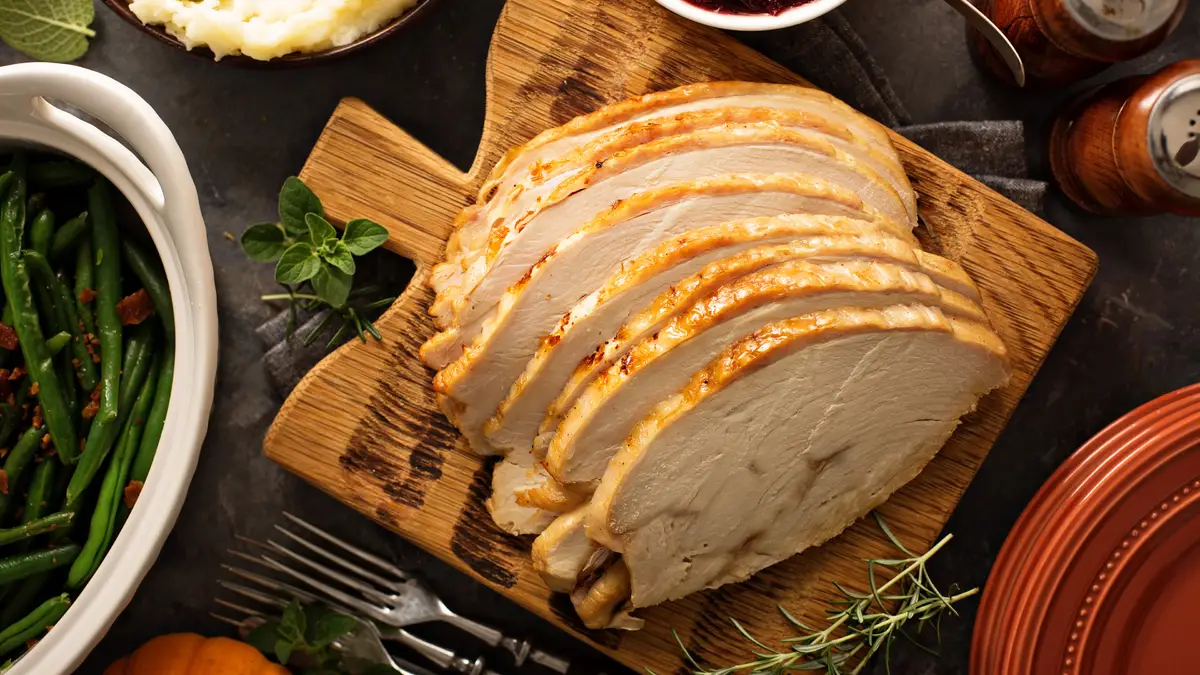
If you're cooking for a smaller group this Thanksgiving, a turkey breast makes a lot more sense than a whole bird. It roasts in about 2 hours, is easy to carve, and nobody has to fight over the white meat. It's also a smart choice if you or someone at your table is watching their sodium, since plain turkey breast is naturally low in sodium. Most of the salt in a holiday turkey comes from what gets added to it, either before it reaches the store or in your own kitchen.
We'll show you how to shop for a turkey breast without added salt, season it with herbs and garlic, and make a gravy that keeps the sodium in check. Our roasted turkey breast recipes, developed by our team of chefs and registered dietitians at the Health eCooks Test Kitchen, are an easy place to start when you’re looking for lower sodium turkey dishes for the holiday.
The turkey breast you bring home can easily have more sodium than anything you add to it. Many turkeys and turkey breasts are injected with a solution to keep the meat moist, and that solution often contains salt. Before you buy, check the package for these terms:
When you're not sure which turkey is lowest in sodium, look at the nutrition facts panel and compare the sodium per serving on a few brands. A turkey breast with nothing added will have the least amount of sodium.
This method comes from our Test Kitchen's roasted turkey breast recipes, with one change to keep the sodium down.
Gravy is where a lot of sodium ends up on a Thanksgiving plate, especially if it comes from a jar or packet. Making it from scratch is easy, and our Roasted Turkey Breast recipe keeps it simple with the pan drippings, a little flour, 2 cups of chicken broth, and 1 cup of apple cider.
Since broth makes up most of that gravy, it's the ingredient to pay the closest attention to. Use an unsalted or low sodium broth, and read the label, because the sodium in chicken broth varies a lot from brand to brand. Skim the fat from the drippings before you start and taste the finished gravy before adding any salt. Between the drippings, the cider, and a few grinds of black pepper, you may find it doesn't need any.
Start with one of our two roasts for a traditional holiday dinner. As for size, our recipes use a 6-pound bone-in breast to serve 8 people, which works out to about 3/4 pound per person. Buy a little more if you're counting on leftovers for sandwiches and soup.
If you're cooking for just a few people, or you want a break from the usual roast, the cutlets, piccata, and London broil all use turkey breast, too.

Total time: 2 hours | 205 calories, 33g protein per serving
For turkey and gravy the traditional way, start here. The breast is covered in herb butter made with garlic, shallot, sage, and thyme, and the pan drippings become a simple gravy with a hint of sweetness from apple cider. To keep the sodium lower, leave the salt out of the herb butter and use unsalted broth in the gravy.

Total time: 2 hours | 291 calories, 36g protein, 4g fiber per serving
This one gives you a main dish and a side from a single pan. The turkey breast roasts on top of onions, carrots, celery, red potatoes, and parsnips, and the vegetables cook in the drippings the whole time. If they need a little longer once the turkey comes out, slide the pan back into the oven while the meat rests. With 36 grams of protein and 4 grams of fiber per serving, it's close to a complete meal on its own.

Total time: 45 minutes | 190 calories, 27g protein, 308mg sodium per serving
Turkey cutlets are thin slices of the breast, so they cook in just 2 to 3 minutes per side. Once they're browned, you make a quick pan sauce with golden sautéed mushrooms, broth, white wine, and fresh rosemary. It's a nice option for a Thanksgiving for two, when even a small roast would leave you with far more turkey than you need. Using unsalted broth will lower the sodium more.

Total time: 45 minutes | 209 calories, 30g protein, 346mg sodium per serving
Lemon, capers, white wine, and blistered cherry tomatoes make this a lighter, brighter take on turkey that would be right at home at a Friendsgiving. Capers are packed in brine, so rinse them well as the recipe directs, and you can cut back on the 1/4 teaspoon of salt, since the capers and lemon add plenty of flavor.

Total time: 35 minutes, plus at least 3 hours to marinate | 238 calories, 34g protein, 340mg sodium per serving
A butterflied turkey breast marinates in balsamic vinegar, low sodium soy sauce, fresh ginger, and scallions, then goes on the grill for about 8 minutes per side. If the weather where you live allows for grilling in late November, it keeps the oven free for the sides. Set it up to marinate the night before, and it's ready to cook whenever you are.
At 325°F, the USDA estimates 1 1/2 to 2 1/4 hours for a 4- to 6-pound whole turkey breast and 2 1/4 to 3 1/4 hours for one that weighs 6 to 8 pounds. Our recipes roast a 6-pound breast at 400°F for about 1 3/4 to 2 hours. Whichever temperature you use, go by a meat thermometer, not the clock, and take the turkey out when the thickest part reaches 165°F.
Plan on about 3/4 pound of bone-in turkey breast per person. A 6-pound breast serves 8, and a bigger one will give you leftovers.
Plain turkey breast is. USDA data lists roasted turkey breast meat at about 100 milligrams of sodium per 100 grams (about 3.5 ounces). The sodium goes up when a turkey is injected with a salty solution, brined, or koshered, or when it's seasoned with a lot of salt at home. For more ways to cut back, see our low sodium diet guidelines.
You can, as long as the turkey breast is completely thawed first and fits in the slow cooker with the lid closed. Cook it until the thickest part reaches 165°F on a meat thermometer. Skin-on turkey won't brown in a slow cooker, so you can remove the skin or crisp it under the broiler for a few minutes before serving.
Leftover turkey keeps for 3 to 4 days in the refrigerator. Refrigerate it within 2 hours of cooking and freeze anything you won't eat in that time. Our guide to storing leftovers safely has more tips.
Every recipe in this article was approved by Jane Schwartz, RDN, CLT, or one of our other Health eCooks registered dietitians for a heart healthy diet. Although they don’t necessarily meet our strict low sodium dietary guidelines (under 140mg per serving), they are lower in sodium than many traditional recipes and we have included tips in this article about how to reduce the sodium further.
Once the turkey is planned, these collections can help you plan your menu, fill in the rest of the table, and even get creative with leftovers:
You’ll also find tips on preparing the turkey and how to cook a frozen turkey on our site.
(Instant Download)
Sign Up for instant access to your free cookbook plus our most popular quick and healthy recipes!