FREEHealthy 30-Minute Meals
(Instant Download)
Sign Up for instant access to your free cookbook plus our most popular quick and healthy recipes!
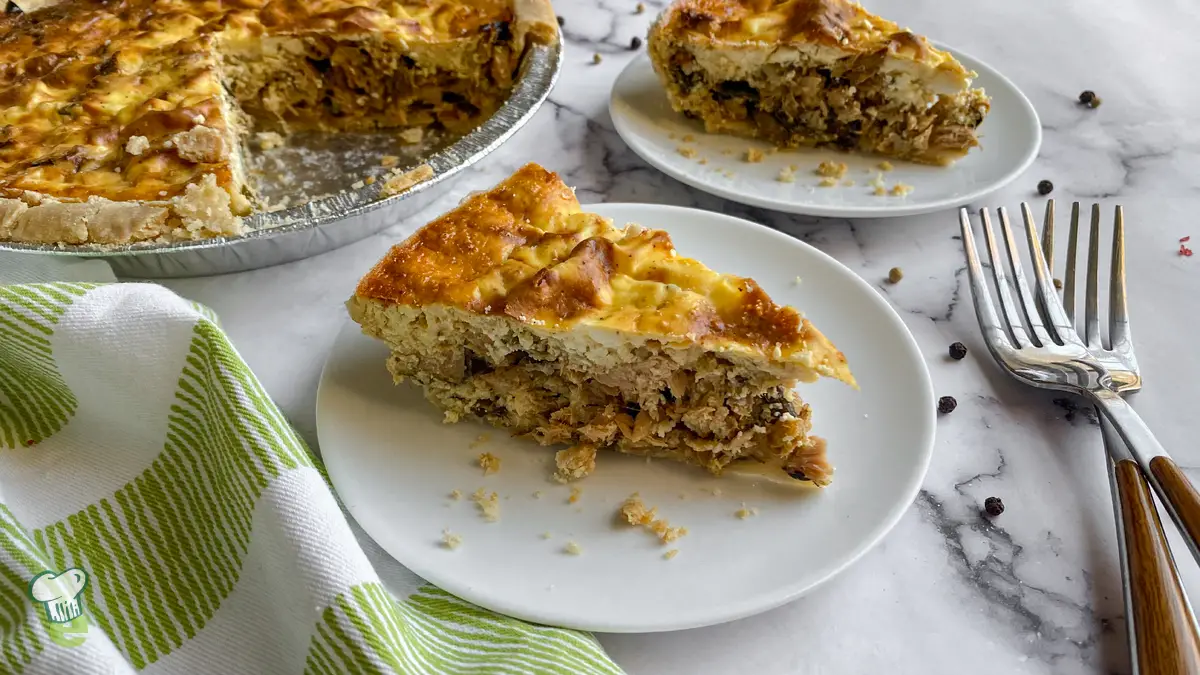
This salmon quiche recipe is the one to make when you want brunch to feel a little special without a lot of work. Flaky wild-caught salmon, tender leeks, and fresh dill bake into a silky custard inside a gluten-free crust, and every slice has 19 grams of protein for just 238 calories.
What makes it different is the custard. Most salmon quiche recipes start with heavy cream or half-and-half and a cup or more of Swiss or Gruyère cheese. Our Health eCooks Test Kitchen built this one on plain nonfat Greek yogurt, eggs, and egg whites, then added just a little crumbled goat cheese for creamy, tangy pockets in every bite. It still slices beautifully and tastes rich, and it has far less sodium than a traditional salmon quiche. Serve it warm for a weekend brunch, pack a slice for lunch, or pair it with a green salad for an easy dinner made almost entirely from pantry staples.
A classic quiche is delicious, but it's usually heavy on cream, cheese, and salt. Our version keeps everything you love about a slice of quiche and makes a few smart changes to the filling.
The biggest change is the custard. In place of heavy cream or half-and-half, we use plain nonfat Greek yogurt, fat-free milk, and a mix of whole eggs and egg whites. That combination adds protein and keeps the texture creamy, without the extra saturated fat and calories that cream adds.
Salmon is the star of the show. It's a good source of protein and omega-3 fats, and canned salmon is also one of the few foods that naturally contains vitamin D. Choosing no-salt-added salmon is a big part of why this quiche is so much lower in sodium than traditional recipes, which often top 500 milligrams per slice.
We also kept the cheese light. Instead of a cup or more of Swiss or Gruyère, just ¼ cup of crumbled goat cheese adds plenty of creamy, tangy flavor. Fresh dill, lemon zest, and black pepper do the rest of the seasoning, so there's no added salt in the filling at all. And because the recipe uses a certified gluten-free crust, it's a great option for anyone who avoids gluten.
Like every recipe on our site, this quiche was reviewed by our registered dietitians, so you can feel good about serving it to your family.
Each slice of this salmon quiche has:
This recipe fits gluten-free, high protein, low carb, GLP-1, and bariatric diets.
(Instant Download)
Sign Up for instant access to your free cookbook plus our most popular quick and healthy recipes!
It depends on the type of salmon. Canned salmon is already cooked, so you can flake it straight into the filling. Fresh salmon should be seared for a few minutes first. This removes extra moisture, adds flavor, and helps the fish flake into even pieces. It will finish cooking in the oven along with the custard.
You can, as long as it's cut into small pieces so it cooks through while the custard sets. We don't recommend it, though. Raw salmon releases liquid as it bakes, which can make your quiche watery. A quick sear in a hot skillet solves that problem and gives you better flavor.
Most quiche isn't gluten-free because the crust is made with wheat flour. The filling of eggs, dairy, vegetables, and protein usually is. This recipe uses a certified gluten-free pie shell, so the whole quiche is gluten-free. If you follow a strict gluten-free diet, check the labels on every ingredient and watch for cross-contact in your kitchen.
It varies a lot depending on the recipe. Quiches made mostly with cream and cheese can be high in calories without much protein to show for it. Each slice of this salmon quiche has 19 grams of protein and 238 calories, thanks to the salmon, eggs, egg whites, and Greek yogurt.
Most salmon quiche recipes include cheese, usually Swiss, Gruyère, or cheddar. We use a small amount of crumbled goat cheese, which has a bold, tangy flavor that pairs well with salmon and dill. A little goes a long way, so you get plenty of flavor while keeping the sodium and saturated fat in check.
Salmon pairs well with many vegetables and herbs. Spinach, asparagus, broccoli, and zucchini are all popular choices. Cook any vegetables before adding them to the filling, and squeeze cooked spinach dry so it doesn't add extra moisture. For herbs, dill is a classic, but chives, parsley, and tarragon work well too.
Smoked salmon works in quiche and adds a rich, smoky flavor, but it's much higher in sodium than no-salt-added canned salmon. If you'd like to try it, use a smaller amount, such as 4 ounces, chopped into small pieces, and know that the sodium per slice will go up quite a bit.
A salmon quiche has a single bottom crust filled with an egg custard. A traditional salmon pie usually has a top and bottom crust or a mashed potato topping, with a filling of salmon, potatoes, and onions instead of custard. If you're looking for an easy canned salmon pie with a lighter, higher protein filling, this quiche is a great place to start.
This quiche fits well into a GLP-1 diet. A single slice has 19 grams of protein in a modest portion, which helps you meet your protein goals when your appetite is smaller. It also reheats well, so you can keep slices in the fridge for quick, satisfying meals throughout the week.
If you love the flavor of salmon, keep the protein coming with these easy recipes from our kitchen:
Looking for more ways to start the day with eggs? These recipes are perfect for brunch, meal prep, or an easy weekday breakfast:
Most quiche problems come down to too much moisture or too much heat. These tips will help you avoid a soggy crust, a watery filling, or a rubbery texture:
If the edges of your crust start to brown before the center is set, cover them with strips of foil or a pie shield and keep baking.
Canned salmon is already cooked, so it goes straight into the filling. If you'd like to use fresh fish, give it a quick sear first. Searing adds flavor, cooks off extra moisture that would otherwise water down the custard, and firms the fish up so it flakes into neat pieces. The fish finishes cooking in the oven, so it only needs a minute or two in the pan.
Start with about 1 pound of skinless salmon fillet, which will give you roughly the same amount of fish as 3 cans once it's cooked. Pat it dry, brush it with 1 teaspoon of olive oil, and season it with a little black pepper. Heat a nonstick skillet over medium-high heat and sear the salmon for 2 to 3 minutes per side, until it's golden on the outside but still slightly translucent in the center. Let it cool for 5 minutes, then flake it into bite-size pieces and use it in place of the canned salmon in step 4.
Fresh tuna makes a meatier quiche. Use about 1 pound of tuna steaks, about 1 inch thick. Pat them dry, brush with 1 teaspoon of olive oil, and season with black pepper. Sear in a very hot skillet for 1 to 2 minutes per side, just until the outside is browned. Tuna can dry out if it cooks too long, so keep the sear short and let the oven do the rest. Once it cools slightly, cut it into ½-inch pieces and add it to the leek mixture in place of the salmon.
For a pantry-friendly tuna quiche, swap the salmon for 3 cans (5 ounces each) of solid white albacore tuna packed in oil. Drain it very well, then pat it with a paper towel to remove extra oil before flaking. Albacore has a mild flavor and a firm texture that holds up nicely in the custard.
Keep in mind that the nutrition information for this recipe is calculated with canned salmon. Using tuna, especia

Recipe yields 8 servings
Preheat the oven to 400°F. Place the frozen pie shell on a rimmed baking sheet and let it stand for 10 minutes to soften slightly. Prick the bottom and sides all over with a fork. Bake for 10 to 12 minutes, until the crust looks dry and is just starting to turn golden at the edges. Set it aside and lower the oven to 375°F.
While the crust bakes, trim off the root end and the dark green top. Cut the leek in half lengthwise, then slice it crosswise into thin half-moons, about ¼ inch thick. Put the slices in a large bowl of cold water and swish them around to loosen any grit. Let them sit for 1 to 2 minutes so the grit sinks. Lift the leeks out with your hands or a slotted spoon, and pat them dry.
Heat the olive oil in a large nonstick skillet over medium heat. Add the leek and cook for 6 to 8 minutes, stirring often, until soft and translucent but not browned. Transfer to a medium bowl and let cool for 5 minutes.
Flake the salmon into the bowl with the leek, removing any skin or large bones. Add the dill, lemon zest, and pepper, and toss gently to combine.
In a second medium bowl, whisk the eggs and egg whites until well blended. Add the Greek yogurt and milk, and whisk until smooth.
Spread the salmon and leek mixture evenly in the pre-baked crust. Sprinkle the goat cheese over the top. Slowly pour the egg mixture over the filling, letting it settle into the gaps.
Bake on the baking sheet for 35 to 40 minutes. The quiche is done when the center is set with only a slight jiggle, a knife inserted 1 inch from the center comes out clean, and the internal temperature reaches 160°F. If the crust edges brown too quickly, cover them with strips of foil or a pie shield.
Let the quiche cool on a wire rack for 15 minutes before cutting it into 8 slices. Refrigerate leftovers, covered, for up to 3 days.
Prefer to skip the pastry? This recipe works just as well without a crust.
To make a crustless salmon quiche, preheat the oven to 375°F and coat a 9-inch glass or ceramic pie dish with olive oil cooking spray. Prepare the leek and salmon filling and the custard as directed. Spread the salmon mixture in the dish, sprinkle with the goat cheese, and pour the egg mixture over the top. Bake for 30 to 35 minutes, until the center is set with only a slight jiggle and the internal temperature reaches 160°F. Let it cool for 10 minutes before cutting it into 8 slices.
Without the crust, each slice has 128 calories, 18 grams of protein, and just 4 grams of carbohydrates. Skipping the pastry also lowers the saturated fat to 2 grams and the sodium to 87 milligrams per slice, so the crustlesss version fits a heart healthy and low sodium diet. If you're watching carbs or just want a lighter, high protein crustless quiche, this is a great way to go.
This quiche keeps well, which makes it a great make-ahead breakfast. Let it cool completely, then cover it tightly or transfer the slices to an airtight container and refrigerate for up to 3 days. To reheat, warm slices in a 350°F oven for 10 to 15 minutes, or microwave a single slice for 45 to 60 seconds. You can also enjoy it cold or at room temperature.
To freeze, wrap individual slices in plastic wrap and then foil, and freeze for up to 2 months. Thaw overnight in the refrigerator before reheating. The custard may be slightly softer after freezing, but the flavor holds up well.
Swap in 3 cans (5 ounces each) of solid white albacore tuna packed in oil, drained. Our tips for making tuna quiche explain how to drain it well. Regular canned salmon also works, but it's higher in sodium than the no-salt-added kind.
Use 1 medium sweet onion, thinly sliced, or 2 large shallots.
Use 2 teaspoons of dried dill, or swap in fresh chives or flat-leaf parsley.
Crumbled feta works well, though it's saltier. Shredded Gruyère or Swiss gives a more classic quiche flavor but adds saturated fat.
Use 1 cup of low-fat cottage cheese blended until smooth. Choose a low sodium brand if you can find one.
Use ¼ cup of liquid egg whites from a carton.
Use unsweetened plain almond milk or soy milk.
From weeknight dinners to make-ahead brunch dishes, our healthy fish and seafood recipes make it easy to enjoy seafood more often. Here are a few collections to get you started: